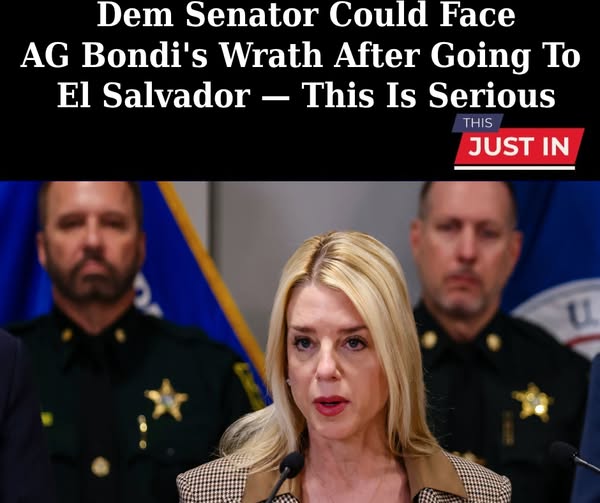
Senator Chris Van Hollen (D-Maryland) has found himself at the center of a growing controversy following his recent diplomatic mission to El Salvador, where he advocated for the release of deportee Kilmar Abrego Garcia. The senator’s unauthorized trip has drawn sharp criticism from Republican lawmakers and conservative commentators who argue that his actions may have violated the Logan Act, a rarely enforced but still active law dating back to the early days of the American republic.
The unusual diplomatic intervention has reignited debate about the boundaries of congressional authority in foreign affairs and raised questions about selective enforcement of a law that has historically been invoked in partisan contexts. As pressure mounts for an ethics investigation, the controversy highlights the complex intersection of immigration policy, separation of powers, and the proper channels for diplomatic engagement.
The Trip: What We Know About Van Hollen’s Mission
Senator Van Hollen traveled to El Salvador without official authorization from the State Department or the Biden administration to advocate for Kilmar Abrego Garcia, a Salvadoran national who was deported from the United States after immigration authorities identified him as a member of MS-13, the notorious transnational gang that has been designated a terrorist organization by the Trump administration.
According to sources familiar with the trip, Van Hollen met with Salvadoran government officials to discuss Abrego Garcia’s case and to advocate for measures that might facilitate his return to the United States. The senator has not publicly detailed the full scope of his discussions with Salvadoran authorities, but his office has confirmed that the primary purpose of the trip was to address Abrego Garcia’s situation.
What makes this intervention particularly controversial is the Trump administration’s prior presentation of courtroom evidence establishing Abrego Garcia’s membership in MS-13, an organization that President Trump has explicitly characterized as comprising “transnational combatants” who pose a direct threat to American security. The classification of MS-13 as a terrorist organization places the group in a category that typically receives heightened scrutiny from both law enforcement and immigration authorities.
Van Hollen’s office has defended the trip as a legitimate effort to assist a constituent’s family member who they believe was wrongfully deported, though they have not directly addressed the evidence regarding Abrego Garcia’s alleged gang ties.
The Logan Act: A Rarely Invoked Legal Prohibition
At the heart of the controversy is the Logan Act, a 1799 law that prohibits unauthorized American citizens from negotiating with foreign governments in disputes involving the United States. The statute specifically forbids any citizen from engaging in correspondence or intercourse with foreign governments or their agents “with intent to influence their measures or conduct” regarding disputes with the United States or “to defeat the measures of the United States.”
Violations of the Logan Act can result in fines or imprisonment for up to three years, though prosecution under the statute would require action by the Department of Justice under the direction of Attorney General Pam Bondi.
The law was enacted during the Adams administration after George Logan, a Pennsylvania doctor and later senator, conducted unauthorized diplomatic meetings with French officials during a period of heightened tensions between the United States and France. Logan, carrying a letter of introduction from then-Vice President Thomas Jefferson, met with French Foreign Minister Charles Maurice de Talleyrand-Périgord in an attempt to ease what has been termed the “Quasi-War” between the two nations.
While Congress viewed Logan’s intervention as an inappropriate intrusion into the executive branch’s foreign affairs authority, the historical record suggests that his unofficial diplomacy may have actually helped reduce tensions. Nevertheless, Congress passed the Logan Act to prevent future unauthorized diplomatic interventions by private citizens.
Historical Context: Enforcement and Invocation of the Logan Act
Despite its long presence in American law, the Logan Act has an extremely limited enforcement history. No one has ever been successfully prosecuted under the Act, and only one person has ever been indicted—that was in 1803, and the case was ultimately abandoned before trial.
However, the law has frequently been invoked in political discourse as a rhetorical tool to criticize perceived diplomatic overreach by political opponents:
- In 1984, the Reagan administration considered charging Rev. Jesse Jackson under the Logan Act after he traveled to Syria and secured the release of a captured American pilot.
- In 2007, House Speaker Nancy Pelosi faced Logan Act accusations after meeting with Syrian President Bashar al-Assad despite the Bush administration’s opposition.
- In 2015, 47 Republican senators who signed an open letter to Iranian leaders during nuclear negotiations were accused by Democrats of violating the Logan Act.
- In 2017, Michael Flynn, then-incoming National Security Advisor to President Trump, became the subject of an FBI investigation partly predicated on potential Logan Act violations after his communications with Russian Ambassador Sergey Kislyak.
This sporadic invocation, almost always along partisan lines and never resulting in prosecution, has led many legal scholars to characterize the Logan Act as a “dead letter” law—technically still on the books but effectively unenforceable due to potential constitutional issues regarding free speech and separation of powers.
The Flynn Parallel: Democrats’ Previous Logan Act Concerns
The current controversy has drawn particular attention due to apparent parallels with the Michael Flynn case, which many Republicans view as evidence of a double standard in how the Logan Act is invoked.
Flynn, who had been designated as incoming National Security Advisor during the Trump transition, had conversations with Russian Ambassador Sergey Kislyak in December 2016, before Trump took office. These conversations, which included discussion of sanctions imposed by the outgoing Obama administration, led to accusations that Flynn had violated the Logan Act by conducting unauthorized diplomacy.
Notes later released from FBI officials suggested that then-Vice President Joe Biden had mentioned the Logan Act as a potential charge against Flynn. FBI agent Peter Strzok’s notes from a January 2017 meeting included the notation “VP: Logan Act,” which many have interpreted as Biden suggesting the statute could be used against Flynn.
The FBI subsequently interviewed Flynn about his conversations with Kislyak, leading to charges that Flynn had lied to investigators. Though then-FBI Director James Comey reportedly remarked that Flynn’s communications appeared “legit,” the investigation ultimately derailed Flynn’s government career and resulted in a guilty plea (which Flynn later sought to withdraw).
Conservative commentators have seized on this history to highlight what they perceive as inconsistent application of the Logan Act based on partisan affiliation.
“Why hasn’t this U.S. senator been arrested for violation of the Logan Act? It’s illegal to conduct your own foreign policy,” tweeted Roger Stone, a longtime Republican operative and Trump ally.
WMAL host Vince Coglianese explicitly drew the Flynn comparison on his radio program: “Is Chris Van Hollen violating the Logan Act? Because this is what they accused General Flynn of doing … the incoming national security advisor … who was merely having conversations with foreign diplomats [after] people had chosen President Donald Trump.”
Legal Analysis: Does Van Hollen’s Trip Constitute a Violation?
Legal experts are divided on whether Van Hollen’s actions meet the threshold for a Logan Act violation, with assessments often falling along ideological lines.
Those who argue the trip could violate the statute point to several key elements:
- Van Hollen acted without official authorization from the executive branch, which maintains primary authority over foreign relations.
- He directly engaged with foreign government officials regarding a matter of U.S. immigration policy.
- His advocacy for Abrego Garcia could be construed as an attempt to “defeat the measures of the United States” regarding the deportation of an alleged MS-13 member.
Those skeptical of a Logan Act violation emphasize:
- As a sitting U.S. Senator on the Foreign Relations Committee, Van Hollen has broader diplomatic latitude than a private citizen.
- Congress routinely engages in foreign travel and diplomatic conversations, often through congressional delegations.
- The Logan Act’s constitutionality remains questionable, particularly as it might infringe on speech and debate protections for members of Congress.
- The case-specific advocacy for an individual deportee might not rise to the level of attempting to influence matters “in relation to disputes or controversies with the United States.”
Jonathan Turley, a constitutional law professor at George Washington University, summarized the tension: “The Logan Act has always existed in this gray area between constitutional powers. Senators regularly travel abroad and engage with foreign leaders on matters of U.S. policy. The question becomes: at what point does that engagement cross from legitimate congressional fact-finding or constituent service into unauthorized negotiation that undermines executive authority?”
The Ethics Complaint: Calls for Senate Investigation
Beyond potential legal considerations, Van Hollen now faces an ethics complaint from the American Accountability Foundation (AAF), a conservative watchdog group. The organization has sent a letter to Senate Ethics Committee Chairman James Lankford (R-Okla.) requesting an investigation into possible violations of Senate rules regarding unauthorized foreign engagement.
“Mr. Abrego-Garcia is essentially an enemy combatant in the ongoing invasion of the United States by transnational gangs,” AAF President Thomas Jones wrote to the heads of the Senate Ethics Committee and Majority Leader John Thune (R-SD). “Despite the overwhelming evidence, Senator Van Hollen decided that he would use Senate funds to fly to El Salvador and advocate for an enemy of the United States.”
Jones added: “Van Hollen was in El Salvador meeting with leaders of the Salvadorian government to attempt to secure Mr. Garcia’s release. It is hard to imagine a more hostile intrusion into U.S. foreign policy than attempting to smuggle a foreign enemy combatant into the United States.”
The ethics complaint raises several distinct issues:
- The potential misuse of Senate resources for a trip that appears to contradict established U.S. policy
- The question of whether Van Hollen properly disclosed the nature of his trip to Senate leadership
- The broader issue of whether such individual diplomatic initiatives undermine the coherence of U.S. foreign policy
While the Senate Ethics Committee operates largely behind closed doors, it has the authority to investigate complaints against senators and recommend disciplinary actions ranging from public reprimand to expulsion. However, the committee is known for its deliberate pace and often resolves matters without formal sanctions.
Political Implications: Broader Context and Motivations
The controversy surrounding Van Hollen’s trip reflects deeper political divisions regarding immigration enforcement, particularly related to gang activity and deportation policies.
The Trump administration has prioritized aggressive enforcement against MS-13, with the president frequently highlighting the gang’s violence in speeches about border security. In contrast, many Democrats have criticized aspects of immigration enforcement as overly harsh and have questioned the reliability of gang designations made by immigration authorities.
Van Hollen, who represents Maryland—a state with a significant Salvadoran population—has been an outspoken advocate for immigrant communities. Prince George’s County and Montgomery County, both in Van Hollen’s state, have substantial Salvadoran American communities that maintain strong ties to relatives in El Salvador.
Political analysts suggest that Van Hollen’s intervention might reflect constituent service for Maryland’s Salvadoran community rather than a deliberate attempt to undermine U.S. foreign policy. However, critics counter that such personal diplomatic initiatives, particularly regarding individuals identified as gang members, create dangerous precedents that could undermine coherent enforcement of immigration laws.
“When senators start conducting their own foreign policy to circumvent lawful deportations, they’re not just pushing constitutional boundaries—they’re potentially sending a message that our immigration laws can be negotiated on a case-by-case basis through political connections,” argued former Department of Homeland Security official Mark Morgan in a television interview.
Separation of Powers: The Constitutional Question
Beyond the specific legal and ethical questions surrounding Van Hollen’s trip, the controversy highlights enduring tensions in America’s constitutional system regarding foreign affairs authority.
The Constitution grants the president significant powers in foreign relations, including the authority to receive ambassadors and conduct diplomacy. However, Congress also maintains important foreign policy roles, including the Senate’s power to ratify treaties and both chambers’ authority over foreign commerce and declaring war.